• Apuntes
  • Vídeos
  • Ejercicios
    • Resueltos
    • Por Curso
      • 1º ESO
      • 2º ESO
      • 3º ESO
      • 4º ESO
      • 1º BACH. CIENCIAS
      • 1º BACH. SOCIALES
      • 2º BACH. CIENCIAS
      • 2º BACH. SOCIALES
  • Más recursos
    • Actividades Interactivas
    • Selectividad (PAU)
    • Acceso Mayores 25
    • LaTeX
Inicio ›EJERCICIOS de Matemáticas ›2º BACH. SOC. ›Matrices, Determinantes y Sistemas ›Selectividad Matrices

Selectividad Matrices

aragónecuacion_matricialEjercicios_Resueltosmatricesselectividad

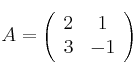
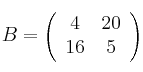
Se consideran las matrices
A = \left( \begin{array}{cc} 2 & 1 \\3 & -1 \end{array} \right)
y
B = \left( \begin{array}{cc} 4 & 20 \\16 & 5 \end{array} \right)

– a) Calcule A^2 y (A^ 2)^{-1}
– b) Despeje X de la ecuación matricial A^2X = B
– C) Calcule X

SOLUCIÓN

A = \left( \begin{array}{cc} 2 & 1 \\3 & -1 \end{array} \right)

A^2=A \cdot A = \left( \begin{array}{cc} 2 & 1 \\3 & -1 \end{array} \right) \cdot \left( \begin{array}{cc} 2 & 1 \\3 & -1 \end{array} \right) = \color{blue}{\left( \begin{array}{cc} 7 & 1 \\3 & 4 \end{array} \right)}

Para calcular la inversa de A^2 usaremos el método de la definición de inversa

A^2 \cdot (A^2)^{-1} = I

\left( \begin{array}{cc} 7 & 1 \\3 & 4 \end{array} \right) \cdot \left( \begin{array}{cc} a & b \\c & d \end{array} \right) = \left( \begin{array}{cc} 1 & 0 \\0 & 1 \end{array} \right)

\left( \begin{array}{cc} 7a+c & 7b+d \\3a+4c & 3b+4d \end{array} \right)  = \left( \begin{array}{cc} 1 & 0 \\0 & 1 \end{array} \right)

\left\{ 7a+c=1 \atop 3a+4c=0 \right. \qquad \left\{ 7b+d=0 \atop 3b+4d=1 \right.

Resolvemos ambos sistemas de ecuaciones

7a+c=1 \longrightarrow c=1-7a
3a+4(1-7a)=0 \longrightarrow 3a+4-28a=0 \longrightarrow -25a=-4 \longrightarrow a=\frac{4}{25}
c=1-7 \cdot \frac{4}{25} \longrightarrow c=\frac{-3}{25}

De la misma forma resolvemos el otro sistema y obtenemos como soluciones b=\frac{-1}{25} y d=\frac{7}{25}

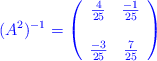
Por tanto la inversa es \color{blue}(A^2)^{-1}= \left( \begin{array}{cc} \frac{4}{25} & \frac{-1}{25} \\ \: & \: \\ \frac{-3}{25} & \frac{7}{25} \end{array} \right)}

A^2X = B
(A^2)^{-1} \cdot A^2X = (A^2)^{-1} \cdot B
X = (A^2)^{-1} \cdot B

X = \left( \begin{array}{cc} \frac{4}{25} & \frac{-1}{25} \\ \: & \: \\ \frac{-3}{25} & \frac{7}{25} \end{array} \right) \cdot \left( \begin{array}{cc} 4 & 20 \\16 & 5 \end{array} \right) = \left( \begin{array}{cc} 0 & 3 \\4 & -1 \end{array} \right)

Comentar el ejercicio

  • 2º BACH. SOC.
    • Estadística
    • PEvAU - SELECTIVIDAD
    • Programación Lineal
    • Matrices, Determinantes y Sistemas
    • Probabilidad
    • Funciones y Derivadas
  • Mapa del sitio
  • Conectarse
  • 2001-2026 — Matemáticas IES — Contactar con Dani