• Apuntes
  • Vídeos
  • Ejercicios
    • Resueltos
    • Por Curso
      • 1º ESO
      • 2º ESO
      • 3º ESO
      • 4º ESO
      • 1º BACH. CIENCIAS
      • 1º BACH. SOCIALES
      • 2º BACH. CIENCIAS
      • 2º BACH. SOCIALES
  • Más recursos
    • Actividades Interactivas
    • Selectividad (PAU)
    • Acceso Mayores 25
    • LaTeX
Inicio ›EJERCICIOS de Matemáticas ›1º BACH. SOC. ›Logarítmos ›ecuaciones logaritmicas y exponenciales

ecuaciones logaritmicas y exponenciales

💬 1

  ecuacionesecuaciones_exponencialesEjercicios_Resueltos

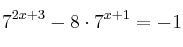
Resuelve la ecuación 7^{2x+3} - 8 \cdot 7^{x+1} = -1

Comentar el ejercicio

Mensajes

  • 15 de febrero de 2007, 00:43, por dani

    7^{2x+3} - 8 \cdot 7^{x+1} + 1 = 0

    Hacemos el cambio de variable: 7^x = t
    7^{2x+3} = 7^{2x} \cdot 7^3 = (7^x)^2 \cdot 7^3 = t^2 \cdot 7^3 = 343t^2
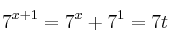
    7^{x+1} = 7^x + 7^1 = 7t
    Sustituimos en la ecuación original:

    343t^2 - 8 \cdot 7t + 1 = 0


    Resolvemos la ecuación de segundo grado (incógnita t)

    343t^2 - 56t + 1 = 0


    t= \frac{56 \pm \sqrt{56^2 - 4 \cdot 343 \cdot 1}}{2 \cdot 343} = \frac{56 \pm 42}{686}


    \left[t=\frac{1}{7} \:, \: t=\frac{1}{49} \right]


    Deshacemos el cambio de variable y obtenemos dos ecuaciones:

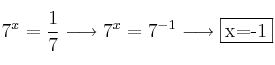
    – 7^x = \frac{1}{7} \longrightarrow 7^x = 7^{-1} \longrightarrow \fbox{x=-1}
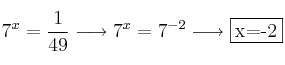
    – 7^x = \frac{1}{49} \longrightarrow 7^x = 7^{-2} \longrightarrow \fbox{x=-2}

  • 1º BACH. SOC.
    • Funciones
    • Inecuaciones
    • Logarítmos
    • Números Reales
    • Polinomios
    • Estadística
    • Probabilidad
    • Variables Aleatorias Unidimensionales
    • Ecuaciones y Sistemas
    • Límites y Derivadas
    • Exámenes
    • Variables Aleatorias bidimensionales
    • Matemática Financiera
  • Mapa del sitio
  • Conectarse
  • 2001-2026 — Matemáticas IES — Contactar con Dani