• Apuntes
  • Vídeos
  • Ejercicios
    • Resueltos
    • Por Curso
      • 1º ESO
      • 2º ESO
      • 3º ESO
      • 4º ESO
      • 1º BACH. CIENCIAS
      • 1º BACH. SOCIALES
      • 2º BACH. CIENCIAS
      • 2º BACH. SOCIALES
  • Más recursos
    • Actividades Interactivas
    • Selectividad (PAU)
    • Acceso Mayores 25
    • LaTeX
Inicio ›EJERCICIOS de Matemáticas ›1º BACH. CIENCIAS ›Sistemas de Ecuaciones ›Sistema 3x3 Gauss

Sistema 3x3 Gauss

Ejercicios_Resueltosgausssistema_lineal_3_ecuaciones_3incógnitas

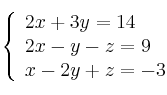
Resuelve el sistema de ecuaciones:
 \left\{
\begin{array}{lll}
2x + 3y = 14 \\
2x - y - z = 9 \\
x -2y + z = -3
\end{array}
\right.

SOLUCIÓN

 \left\{ \begin{array}{lll} 2x + 3y = 14 \\ 2x - y - z = 9 \\ x -2y + z = -3\end{array} \right. \longrightarrow \left( \begin{array}{ccc|c} 2 & 3 & 0 & 14 \\ 2 & -1 & -1 & 9 \\ 1& -2& 1 & -3\end{array} \right)

Intercambiamos las filas 1 y 3

\left( \begin{array}{ccc|c} 2 & 3 & 0 & 14 \\ 2 & -1 & -1 & 9 \\ 1& -2& 1 & -3\end{array} \right) F_1 \leftrightarrow F_3 \left( \begin{array}{ccc|c} 1 & -2 & 1 & -3 \\ 2 & -1 & -1 & 9 \\ 2& 3& 0 & 14\end{array} \right)

2 \cdot F_1 - F_2 \longrightarrow F_2
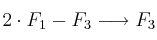
2 \cdot F_1 - F_3 \longrightarrow F_3

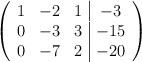
\left( \begin{array}{ccc|c} 1 & -2 & 1 & -3 \\ 0 & -3 & 3 & -15 \\ 0& -7& 2 & -20 \end{array} \right)

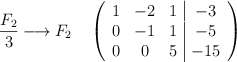
Observamos que en la segunda fila todos son múltiplos de 3. Podemos dividir por 3 para simplificar cálculos
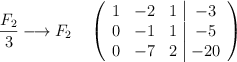
\frac{F_2}{3} \longrightarrow F_2 \quad \left( \begin{array}{ccc|c} 1 & -2 & 1 & -3 \\ 0 & -1 & 1 & -5 \\ 0& -7& 2 & -20 \end{array} \right)

Finalmente hacemos 7 \cdot F_2 - F_3 \longrightarrow F_3
\frac{F_2}{3} \longrightarrow F_2 \quad \left( \begin{array}{ccc|c} 1 & -2 & 1 & -3 \\ 0 & -1 & 1 & -5 \\ 0& 0& 5 & -15 \end{array} \right)

Pasamos a ecuaciones y resolvemos de abajo hacia arriba
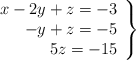
 \left. \begin{array}{rrr} x -2y + z = -3 \\  - y + z = -5 \\ 5z = -15\end{array} \right\}

5z = -15 \longrightarrow z = \frac{-15}{5} \longrightarrow \color{red}{z =-3}

- y + z = -5 \longrightarrow -y-3=-5 \longrightarrow \color{red}{y =2}

x -2y + z = -3 \longrightarrow x -2\cdot 2 -3 = -3 \longrightarrow \color{red}{x =4}

Comentar el ejercicio

  • 1º BACH. CIENCIAS
    • Derivadas
    • Números Reales
    • Sucesiones
    • Logaritmos
    • Polinomios y Fracciones Algebraicas
    • Exámenes
    • Ecuaciones
    • Números Complejos
    • Sistemas de Ecuaciones
    • Trigonometría
    • Inecuaciones
    • Ecuaciones Exponenciales y Logarítmicas
    • Funciones (I)
    • Geometría en el Plano
    • Cónicas
    • Funciones II
    • Integrales
    • Probabilidad
  • Mapa del sitio
  • Conectarse
  • 2001-2026 — Matemáticas IES — Contactar con Dani